Choosing a cage for a growing pet is not simply a matter of buying the largest model available. Species, adult body size, activity level, and daily exercise all matter. A young hamster may fit comfortably today, yet outgrow a narrow enclosure within weeks. A rabbit may need room for stretching, hopping, hiding, and using separate toilet areas.
The American Pet Products Association’s 2023–2024 National Pet Owners Survey estimated that 66% of U.S. households owned a pet, representing about 86.9 million homes. That scale reflects a growing need for informed housing decisions. However, popularity does not equal proper care. The RSPCA and PDSA Animal Wellbeing Report both emphasize space, enrichment, movement, and species-specific behavior. These principles are more useful than relying on a cage label that says “large.”
So, how to choose cage size for growing pets? Start with the pet’s expected adult measurements, not its current size. Measure usable floor space, height, door access, bar spacing, ventilation, and room for enrichment. A cage should allow natural movement without forcing awkward posture. It should also fit safely inside your home, with enough surrounding space for cleaning and handling.
This guide compares seven practical cage sizes for growing pets, from compact habitats to spacious indoor enclosures. The recommendations reflect veterinary guidance, welfare standards, and real household constraints. Some choices remain imperfect. A larger cage cannot replace supervised exercise, thoughtful enrichment, or regular observation. Growth is unpredictable, too. Recheck the setup every few weeks, especially after noticeable changes in weight, posture, or behavior.
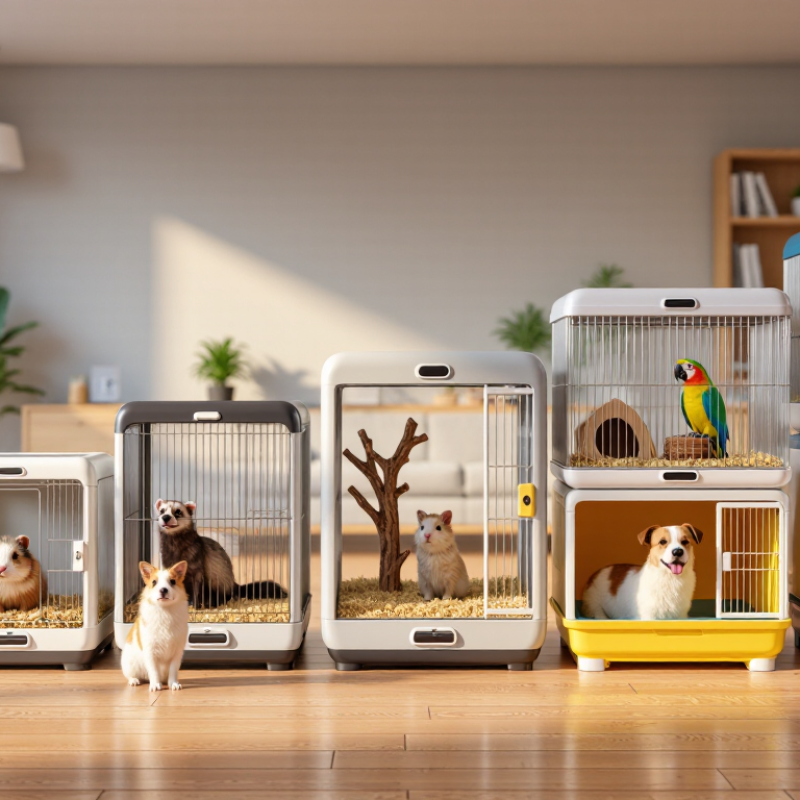
Define cage sizing by adult body length, activity, and growth stage
7 Best Cage Sizes for Growing Pets: How to Choose?
Cage size should follow adult body length, daily activity, and growth stage. Measure from nose to rump, excluding the tail. For planning, seven useful adult-length bands are under 10 cm, 10–20 cm, 20–30 cm, 30–40 cm, 40–60 cm, 60–80 cm, and over 80 cm. These bands are starting points, not universal rules.
Choose an enclosure with an internal length at least two to three times the adult body length. Active climbers need greater height, while running species need more uninterrupted floor space. Add room for bedding, hides, feeding areas, and safe movement. A young pet may fit a smaller enclosure, but rapid growth can make it unsuitable within weeks. Adjustable dividers can help, provided they never reduce ventilation or exercise space.
I once selected a cage based on the animal’s current size. It looked spacious on day one. That was a poor assumption. The adult length and movement pattern mattered more. Check growth records, species-specific welfare guidance, and advice from an experienced veterinarian. Watch the pet for repeated pacing, crouching, climbing on the walls, or avoiding certain areas. Those behaviors may indicate poor design, although they can also reflect stress or illness. Reassess the enclosure after every major growth stage. Measure again. Baebele?
Compare seven size tiers using RSPCA’s 3 m × 2 m × 1 m rabbit benchmark
7 Best Cage Sizes for Growing Pets: How to Choose?
Choosing a cage for a growing pet requires more than checking its current body length. Measure the adult size, stretching space, turning room, and daily activity needs. For rabbits, a widely cited welfare benchmark is
3 m × 2 m × 1 m.
It represents usable living space, not a small sleeping box.
3 m × 2 m × 1 m represents usable living space, not a small sleeping box.
Tier one, 0.6 m × 0.4 m × 0.4 m, suits transport only.
Tier two, 1 m × 0.6 m × 0.6 m, remains too restrictive for long-term rabbit housing.
Tier three, 1.2 m × 0.8 m × 0.8 m, may fit a young animal briefly.
Tier four, 1.5 m × 1 m × 1 m, offers more movement but still limits energetic adults.
Tier five, 2 m × 1.2 m × 1 m, works better for temporary indoor management. It is not the benchmark.
Tier six reaches 3 m × 2 m × 1 m. This allows hopping, stretching, and separate toilet and resting areas. Tier seven adds enrichment, such as tunnels, platforms, digging boxes, and safe hiding corners, within at least 3 m × 3 m × 1.5 m.
Bigger is not automatically better. Poor flooring, sharp edges, or constant noise can still reduce welfare.
I once underestimated vertical clearance. Rabbits need to stand upright without touching the roof.
Recheck measurements as the animal grows. A cage can look generous beside a young pet, then feel surprisingly small within months.
Apply Blue Cross’s 100 × 50 cm hamster minimum to small-mammal cages
Cage size shapes a small mammal’s daily life. For hamsters, use 100 × 50 cm as the minimum floor area. This equals 5,000 cm² of uninterrupted space. Floor area matters more than height. A tall cage cannot replace usable ground space.
This benchmark follows UK welfare guidance for hamster housing. Research published in Applied Animal Behaviour Science found fewer repetitive behaviours in larger hamster enclosures. A 2023 small-mammal welfare review also linked deeper bedding with more natural digging. Provide at least 20 cm of safe bedding where possible. Add a solid wheel, hides, tunnels, and several food-search points. Measure the internal floor, not the outside frame. Bar gaps need checking too. Small bodies exploit weak designs.
Tips: Place the enclosure in a quiet room. Keep one side visually sheltered. Watch climbing, digging, eating, and resting. These behaviours reveal comfort better than appearance. Avoid crowding every corner with accessories. Open space still matters.
The 100 × 50 cm rule is useful, but it is not perfect. A nervous hamster may need more cover, while an active animal may need more roaming space. My practical adjustment would be simple: increase floor area whenever the budget and room allow. Record changes for two weeks. Then review the animal’s behaviour, bedding use, and sleep pattern. One measurement cannot describe every individual.
7 Cage Sizes for Growing Pets: How to Choose?
Comparison of example small-mammal enclosure footprints against a 100 × 50 cm minimum reference area. Larger floor areas provide more room for movement, enrichment, and separate resting zones.
Floor area is calculated as width × depth. The reference area is 5,000 cm².
Use AAV and ARAV guidance for bird flight space and reptile thermal gradients
Choosing the right cage size means planning for movement, not merely fitting a pet inside. Guidance from the Association of Avian Veterinarians emphasizes usable flight space for birds. The enclosure should let a bird stretch, flap, turn, and move between perches without striking walls or toys. Bigger is generally safer, especially for active species. A narrow cage can restrict wing exercise, even when its height looks impressive.
Measure the bird with fully extended wings. Leave clear horizontal space around that span. Place perches at different heights, but keep a central flight path open. Food bowls, ropes, and toys should not create a crowded obstacle course. Supervised time outside the cage can add exercise, but it should not excuse inadequate housing. This is where many owners, including experienced ones, may underestimate daily movement.
For reptiles, Association of Reptile and Amphibian Veterinarians guidance supports an enclosure with a real thermal gradient. One end should provide appropriate warmth, while the opposite end stays cooler. The animal must be able to choose between them. Measure temperatures at ground level and near basking surfaces, because air readings can mislead. Use guarded heating equipment and reliable controls. A large enclosure is not automatically suitable if heat spreads evenly throughout it. Species, age, behavior, and growth rate all matter. I still recheck the layout after adding one branch or hide; a small change can block the cool retreat.
7 Best Cage Sizes for Growing Pets How to Choose? - Use AAV and ARAV guidance for bird flight space and reptile thermal gradients
| Pet and life stage |
Practical enclosure size |
Minimum internal dimensions |
Key space requirement |
Thermal or ventilation target |
How to choose |
Budgerigar
One or two adults |
Flight cage |
30 × 18 × 18 in
(76 × 46 × 46 cm) |
The longest dimension should allow several uninterrupted wingbeats. Use horizontal space rather than excessive height. |
Strong cross-ventilation; avoid drafts, direct sun, and rapid temperature changes. |
Choose a cage with safe bar spacing of about 1/2 in or less and enough room for exercise after perches and toys are installed. |
Lovebird
One or bonded pair |
Wide flight cage |
32 × 20 × 20 in
(81 × 51 × 51 cm) |
Provide a clear central flight path and multiple perching levels without crowding. |
Good airflow without exposed drafts; include shade and a stable day-night cycle. |
Use bar spacing of approximately 1/2 in or less. Increase width when adding a second bird. |
Cockatiel
One adult or pair |
Large flight cage |
36 × 24 × 30 in
(91 × 61 × 76 cm) |
Width is especially important because flight should remain possible with perches, food bowls, and enrichment inside. |
Well-ventilated wire enclosure; provide a sheltered area and protect from overheating. |
Select bar spacing around 1/2 to 5/8 in, with no head traps or sharp welds. |
Small parrot
Conure-sized adult |
Extra-wide flight cage |
36 × 24 × 36 in
(91 × 61 × 91 cm) |
Allow full wing extension and a clear flight route; include chewable and foraging enrichment. |
Use durable, non-toxic materials and excellent ventilation; avoid fumes from overheated nonstick coatings. |
Bar spacing is commonly about 5/8 to 3/4 in, but the bird's head must never fit between bars. |
Leopard gecko
Growing juvenile to adult |
Ground-level terrarium |
36 × 18 × 18 in
(91 × 46 × 46 cm) |
Provide a warm hide, humid hide, cool hide, usable floor area, and secure climbing or cover structures. |
Warm surface area about 88–92°F (31–33°C); cool side about 75–80°F (24–27°C). Measure with digital probes. |
Prioritize floor length and a measurable warm-to-cool gradient over a tall but narrow enclosure. |
Bearded dragon
Juvenile to adult |
Large desert enclosure |
48 × 24 × 24 in
(122 × 61 × 61 cm) |
Use a broad basking platform, shaded retreat, low climbing surfaces, and unobstructed walking space. |
Basking surface about 100–110°F (38–43°C); cool side about 75–85°F (24–29°C). Provide strong, species-appropriate UVB. |
A 4-foot enclosure is a practical adult baseline; upgrade early if the juvenile outgrows its thermal gradient. |
Veiled chameleon
Growing juvenile to adult |
Tall, well-ventilated enclosure |
24 × 24 × 48 in
(61 × 61 × 122 cm) |
Create dense horizontal and diagonal branches, leafy cover, and separate upper basking and lower cooling zones. |
High ventilation is essential; upper basking area commonly reaches about 85–95°F (29–35°C), with cooler lower areas. |
Choose a screen or hybrid design that supports airflow, safe lighting above the enclosure, and reliable humidity control. |
Selection note: These dimensions are practical planning baselines for healthy animals and should be increased whenever possible. Bird cages should preserve usable flight space after furnishings are added. Reptile enclosures must support a measurable thermal gradient, appropriate ultraviolet lighting where required, hiding places, and species-appropriate ventilation. Temperature values are approximate operating targets; verify them with calibrated digital instruments and adjust for the individual animal, enclosure design, and veterinary advice.
Check ventilation, enrichment, cleaning access, and 20% growth allowance
7 Best Cage Sizes for Growing Pets: How to Choose
Choosing a cage size is not only about fitting your pet today. Leave at least 20% extra room for healthy growth, movement, and changing equipment. A young rabbit, hamster, bird, or reptile may look tiny at first. That can be misleading. Measure the adult body length, then add space for stretching, turning, feeding, and resting. My first setup seemed large, but a hide, bowl, and exercise area quickly reduced usable floor space.
Ventilation matters as much as size. Look for steady airflow without placing the cage in a cold draft. Wire spacing must prevent escapes and protect toes, noses, or wings. Enrichment should fit naturally, not block every pathway.
Add safe climbing areas, tunnels, chew items, or textured surfaces according to the species. Cleaning access also deserves attention. Large doors, removable trays, and reachable corners make daily care more realistic. Poor access can quietly lead to neglected messes.
Tips: Sketch the cage on paper first. Mark the sleeping area, food station, toys, and cleaning route. Check whether your hand can reach the farthest corner. Ask an exotic-animal veterinarian or experienced keeper about adult dimensions and species needs. Recheck the setup each month. Growth is uneven, and the “perfect” size may need revision.
Conclusion
Choosing the right enclosure is essential for the comfort, safety, and healthy development of growing pets. This guide explains how to choose cage size for growing pets by considering the animal’s expected adult body length, activity level, movement needs, and growth stage. It compares seven practical size tiers, from compact habitats for tiny, less active animals to large enclosures for pets that need room to run, climb, stretch, or fly. As general planning references, rabbit housing should provide several meters of usable space, while small-mammal habitats should offer at least 100 × 50 cm of floor area.
The guide also covers species-specific priorities, including open flight space for birds and separate warm and cool areas for reptiles. Beyond dimensions, owners should evaluate ventilation, enrichment, cleaning access, and secure construction. Adding about 20% extra space for future growth can prevent frequent upgrades and support long-term welfare.

 Brisk Pet